
About Baptism
“Holy Baptism is the basis of the whole Christian life, the gateway to life in the Spirit (vitae spiritualis ianua), and the door which gives access to the other sacraments. Through Baptism, we are freed from sin and reborn as sons of God; we become members of Christ, are incorporated into the Church, and made sharers in her mission: ‘Baptism is the sacrament of regeneration through water in the word.’” (Catechism of the Catholic Church, 1213)
Welcome! We are so glad you’re here. Please fill out the baptism inquiry form below to begin the process of having your child baptized. Once you complete the form, you will receive an email with further instructions. Baptisms are celebrated on Sundays at 1:30 PM.
Baptism Inquiry Form
St. Paul the Apostle Baptism Preparation
St. Paul the Apostle Catholic Church welcomes you and your child! If your child is still on his or her way or here already and is less than seven years old, this is the place to begin the steps toward Baptism.
Throughout the United States, Catholic churches wish the parents to be prepared for the ongoing responsibility of raising a child in the faith. Here are the steps needed to prepare your child for Baptism at St. Paul’s:
- Register to become a member of the parish: At St. Paul the Apostle Catholic Church, we first encourage you to be a parish member. In asking to have your child baptized, you are accepting the responsibility of preparing your child in their lifelong practice of the Catholic faith. After becoming a parish member, you will be able to access the religious education and support you may need to fulfill that desire. You can complete your parish registration online, pick up a form at a weekend Mass or from the church office during regular office hours.
- Complete the Online Baptism Registration to register for the Baptism and the Baptism Preparation Class. This form must be completed and submitted along with a state-issued birth certificate before a Baptismal certificate can be issued. Baptisms will not be scheduled until this birth certificate is brought to class or the parish office.
- Complete the Pre-Baptism Workshop, which is offered on the third Sunday of each month:
- Please arrange to attend one of the Pre-Baptism Workshops through our Sacramental Records Specialist, Barb Couts (bcouts@stpacc.org). These meetings will be led by a clergy member, and will take place on the third Sunday of each month at 1:30pm. You will be with other couples, and this is your opportunity to ask questions about the Rite of Baptism, Godparents, etc.
- Godparent Information: Please read the Godparent information page to register and have them complete the necessary paperwork.
- After you have completed these steps and submitted all the necessary paperwork, Barb Couts will assist you with scheduling your child’s Baptism.
What is Baptism?
Baptism is the sacrament- the outward, physical sign manifesting a divine action, an inward grace- by which we both embrace and are embraced by the redemption won for us by Christ. Through Baptism, we enter “heavenly” life, that is, life with God.
The word baptism is Greek and means to “plunge” or “immerse” (CCC 1214). Baptism is the “door” or “gateway” to a spiritual life in Christ. Through Baptism, one is freed from original sin and all past sins, reborn as an adopted child of God, initiated into the Church, and “bonded” to other Christians. Through sanctifying grace that comes from being baptized, one is strengthened against sin and protected from death.
All humanity is caught in a system of sin; our very life, every advantage, and privilege are made forfeit by our sin and the heritage of sin that we inherit. Every good work, every offering to God, is empty of meaning and can gain no access to God because it is covered by injustice. Thus, we need justification; some satisfaction must be offered. However, we, by our own merits, cannot obtain this satisfaction because what we have spurned is infinite in value, and our works are finite. Therefore, only one who was himself greater than all created goods could make an offering suitable for satisfaction. By Baptism, we all participate in this offering and make it our own. Our sins are washed away by a new, free, and unmerited grace.
The newly Baptized are reborn as a son or daughter of God, an ark for the Holy Spirit to dwell within. It is the way in which one enters and embraces our status as a child of God, and this relationship, as the relationship of any child to their parent, is established as a permanent reality. We speak of this permanent state of relationship with God, this divine adoption, as an “indelibly marked” that can never be destroyed even by sin.
Baptism makes us members of the Church, which is the Body of Christ. We become part of “a chosen race, a royal priesthood, a holy nation, a people of his own, so that you may announce the praises” 1 Peter 2:9. Baptism initiates a common bond with all Christians seeking to be in communion with the Trinitarian God (Father, Son, and Holy Spirit). A common group of people who have been saved by their faith in Jesus Christ through the grace of Baptism.
Who can be baptized and who can baptize?
Anyone who has not been baptized and has been instructed in preparation for receiving God into their life can be baptized. Infants and young children can be baptized if their parents and/or Godparents have received instructions and pledge to foster the child’s Christian faith.
Anyone can baptize someone if they have the right intentions and follow the appropriate rite (CCC 1256). This is used solely for emergencies when someone is about to die, and a Catholic Priest or Deacon is not available. A right intention entails the desire to fulfill the purpose of Baptism as per the Catholic Church. The rite requires water and specific words and actions to be valid.
When can you be Baptized?
From the moment after birth until the moment before death. It is never too early or too late to be born again in the Holy Spirit and marked as a child of God. Before Baptism, one should be appropriately instructed in the meaning and purpose of this beautiful and life-changing sacrament of initiation.
Where can you get Baptized?
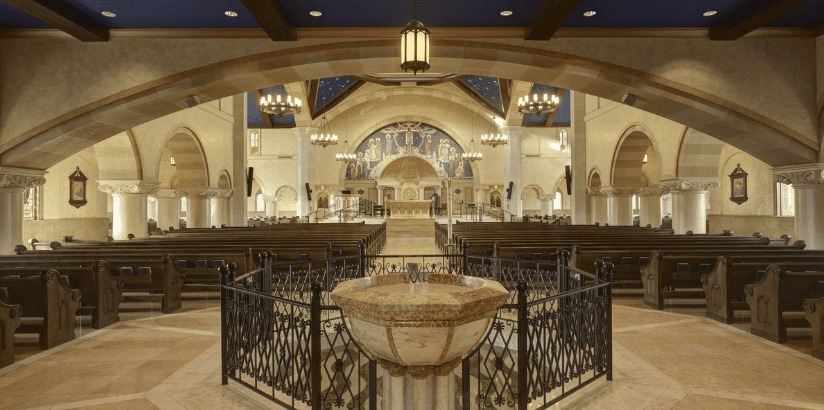
In ancient times, it was outside of a church since it was a “prerequisite” or “gateway” to entering full communion with the Church. It might have even been at a river or lake. Now, most Baptisms are performed within a church at a baptismal font, which could be in the narthex, the back of the church, or near the altar. This format has been adopted because most baptisms are for infants, and those who are being baptized are no longer restricted from entering the church sanctuary. Also, since Baptism is the sacrament by which we enter the Church, it is fitting that Baptism is done in a church, the place dedicated as the common home of the faithful and the house of God. This is also why Baptisms should be done by the priests or deacons because they stand at the head of the household, the community.
Why do Catholic Christians get Baptized?
Christians are baptized first and foremost because it is the sign that Christ established for becoming his discipline and participating in the victory over sin that he won for us: “Go therefore and make disciples of all nations, baptizing them in the name of the Father, and of the Son, and of the Holy Spirit.” Matthew 28:19
Christians are baptized to begin a permanent relationship with God. It is the first step in a journey towards the paradise that God our Father has prepared for us. It cleanses us from original sin that we received from Adam and Eve. It does not remove our tendency to sin, or concupiscence, but through sanctifying grace, we are strengthened against it.
Baptism is the prerequisite or gateway to all the other sacraments. One cannot receive the other sacraments or be in full communion with the Church until they have been baptized. It is the ordinary means by which we enter eternal life, by which we receive the redemption won by Christ, outside of which there is no salvation. While this is the certain path established by Christ, it does not mean that redemption is impossible for those who are not baptized. While we are bound to enter communion with God through the concrete means through which he promised to act, God’s actions in the world are not limited to the sacraments, and each person will be judged according to their desire to seek God and participate in his plan.
This applies in a special way to those who pass from this life in infancy before Baptism. These we commend to the mercy of God who will not condemn the innocent. We should not, however, relativize or cheapen the Sacrament of Baptism because it is the sacrifice of Christ; by it, we are washed in the blood of the Lamb. By the Baptism of the child, we recognize and affirm that there is no redemption outside of Christ.