
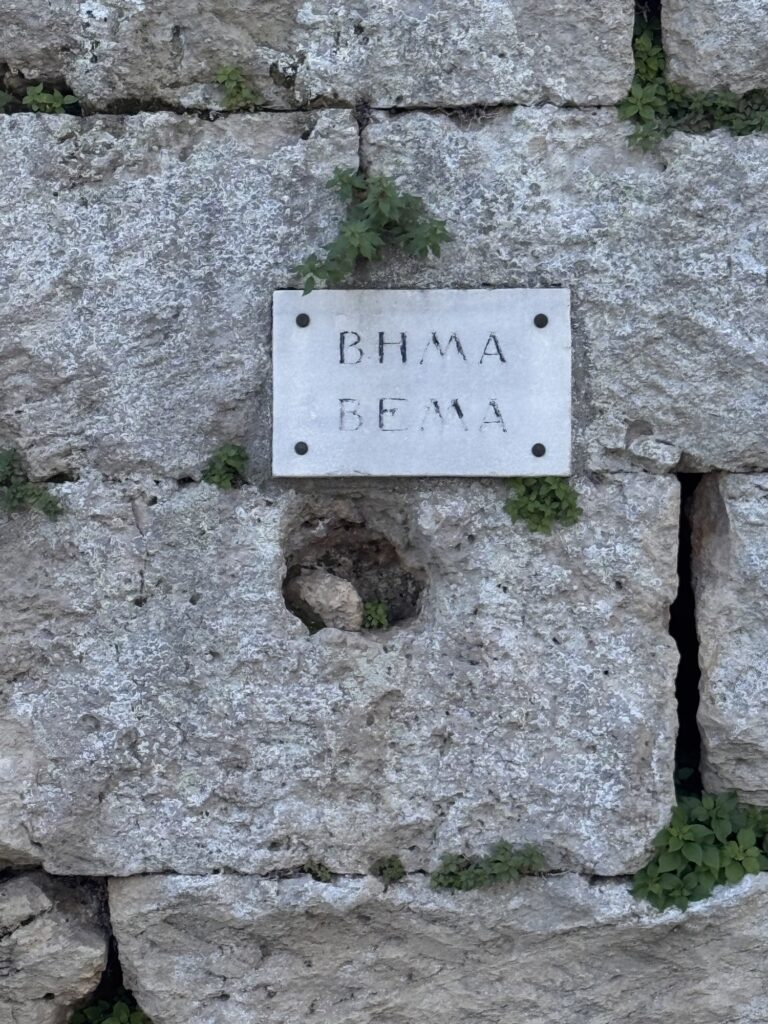
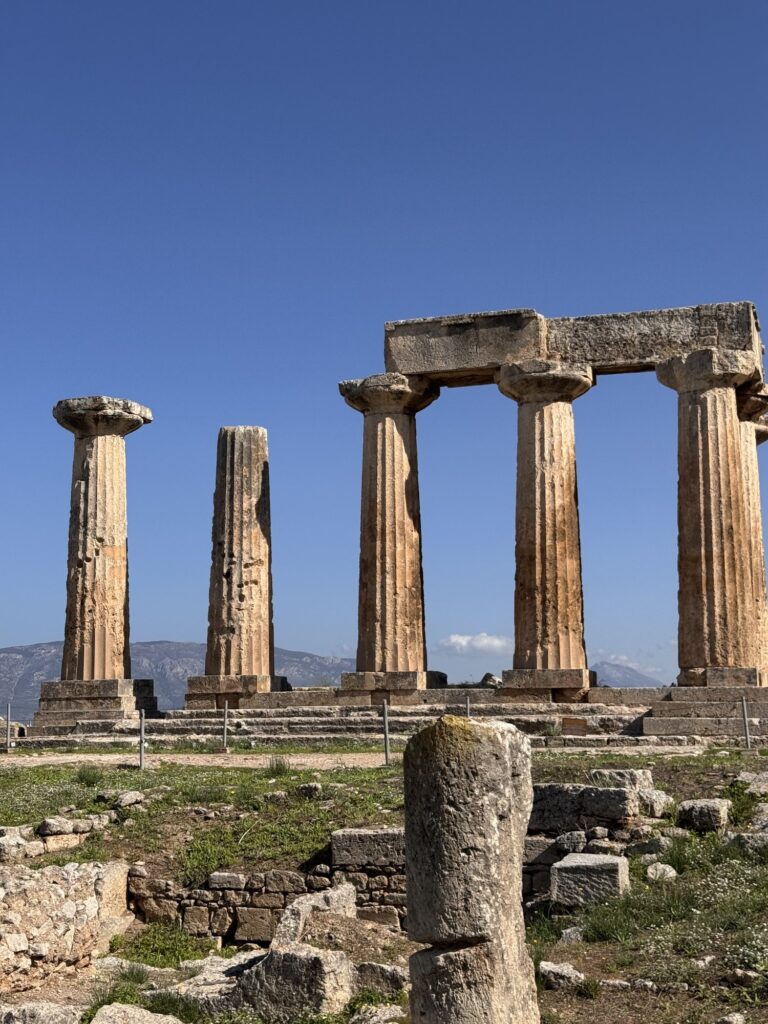
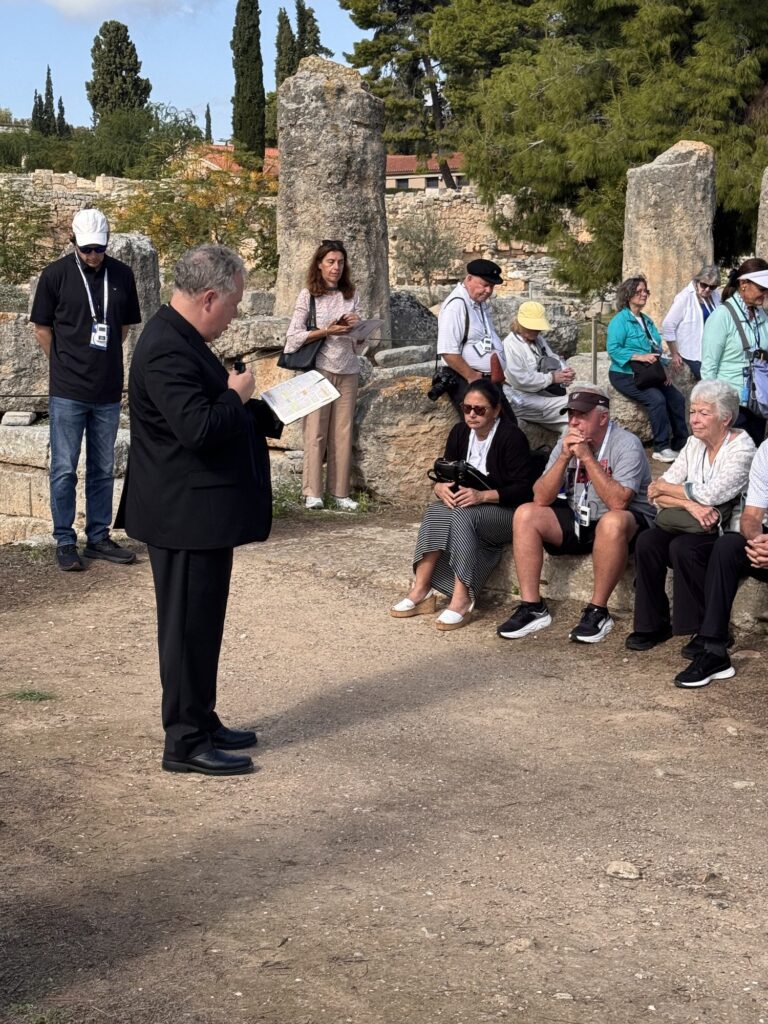
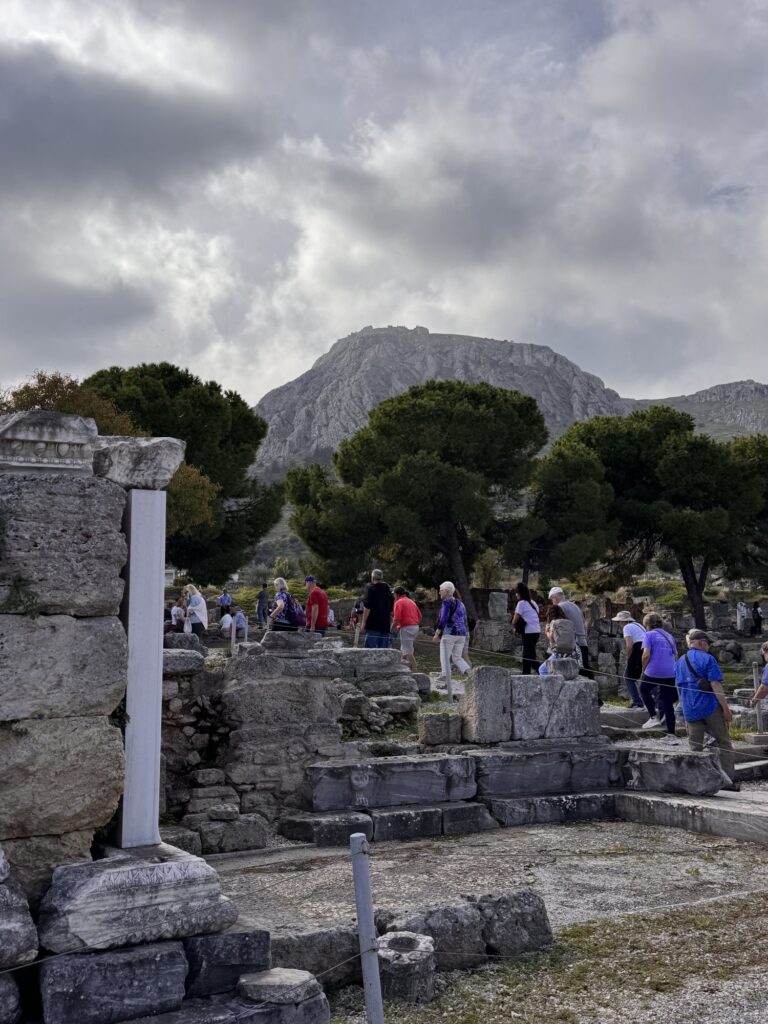
On Thursday, October 22, our pilgrims walked the ruins of ancient Corinth, where St. Paul lived and worked for a year and a half, making tents and founding the Church (Acts 18). Fr. Wilson celebrated Mass at the bema, the raised stone platform where Paul was dragged before the Roman proconsul Gallio to be accused by local Jewish leaders (Acts 18:12-17). It was also the memorial of Pope St. John Paul II.
Homily at the Bema
Our Lord said, “I have come to set the earth on fire, and how I wish it were already blazing!” (Luke 12:49). That fire, of course, is the fire of God’s love in our hearts. It’s the fire of love: the image of the Sacred Heart of Jesus, his heart inflamed with the fire of divine love. And we’re invited here now to ask the Lord for the grace to set our hearts on fire with the fire of God’s love.
We’re here in the place where arguably the most beautiful words ever written about love were sent, in a letter from the Apostle Paul to the Corinthians. We heard those words just before Mass: “Love is patient, love is kind” (1 Corinthians 13:4). I encourage you to search all of the ancient writings and all of the ancient philosophers to find anything like that. I would argue you won’t. This represents something new in human history, this notion of love.
The Apostle Paul, who wrote so beautifully, was not inventing this notion of love. He was simply describing what it means to live in Christ, to live his love: the newness that Jesus introduced into history, a new kind of love. We heard from St. Paul’s letter to the Ephesians the invitation that Christ would be at the center of our lives, that we would live the very life of Christ (Ephesians 3:14-21). And so our Lord is inviting you and inviting me to open our hearts, to let them be set on fire.
And he asks a somewhat perplexing question: “Do you think that I have come to establish peace on the earth?” Of course we say, “Yes, Lord! You’re the one who said, ‘Peace be with you.’ You’re the one who said, ‘I offer you peace; not as the world gives do I give it to you.’” But our Lord is also showing us the authentic way to peace. He is breaking down the idea that our greatest loyalty would be to our family, as important as family is. He is introducing a new loyalty, a loyalty to him. We must decide for him, and we must be willing to experience the painful reality of division.
Not that we celebrate division, or want it, or somehow rejoice in it, but that we have this fundamental commitment to him, no matter the cost, even if it means experiencing the greatest of pains, which would be division in our family. But he also shows us the pathway to peace and reconciliation in the family. When we make him truly first in our life, that is the pathway to the healing, the strengthening and the restoration of the family, which is the basis of society. And so again, we are invited to make that decision, to be faithful to the Lord in all things.
We see in the Apostle Paul a man who made this fundamental decision to be a disciple of Jesus Christ, and who suffered all things for the sake of love. It was that great love that brought Paul to Corinth, to a place that was considered lost, full of lost and confused people. He didn’t write them off. He didn’t say, “I’ll have nothing to do with you.” He came here to share the good news of Jesus.
We’re invited to be inspired by that. With hearts set on fire with the fire of God’s love, how can we, who are called to be disciples, love so greatly that we would bring the good news of Jesus to the people and the places we so easily write off? We need that conviction: the good news is for everyone.
That’s our invitation today: to be inspired by the great love of St. Paul the Apostle, whose love drove him to come here, to labor here, to proclaim Jesus Christ here, in the very heart of the pagan, Greco-Roman world. He had encountered the good news that every human heart is longing for.
As we celebrate this day in honor of Pope St. John Paul II, we see in him a modern example. All of us remember his time as pope. He showed us what it means to have a heart set on fire: a heart that invited us to open wide the doors of our hearts to Christ, that encouraged the whole world not to be afraid, and that brought him to the ends of the earth to proclaim the good news of Jesus Christ.
On his memorial today, we ask his intercession in a special way, that we would be faithful to the mission we have received: first to receive the good news and let it be good news for us, and then to ask the Lord, “How can we be those who share this good news?”
Cenchreae: Where Paul Set Sail
A short distance from Corinth, the pilgrims stopped at the seashore of Cenchreae, the port where Paul’s time in Corinth came to an end.
Paul remained for quite some time, and after saying farewell to the brothers he sailed for Syria, together with Priscilla and Aquila. At Cenchreae he had his hair cut because he had taken a vow.
Acts 18:18
“This is the spot where St. Paul concluded his ministry in Corinth and then sailed from here to Ephesus. Here he renewed his consecration to God through a special vow, and he cut his hair in the Jewish tradition as a public sign of his consecration, his renewed promises to God. Friends, we can be inspired by St. Paul’s missionary zeal, which took him over 10,000 miles over 15 years. He traveled and sacrificed for the sake of the Gospel. He renewed his dedication to God. We’re invited to do the same.”