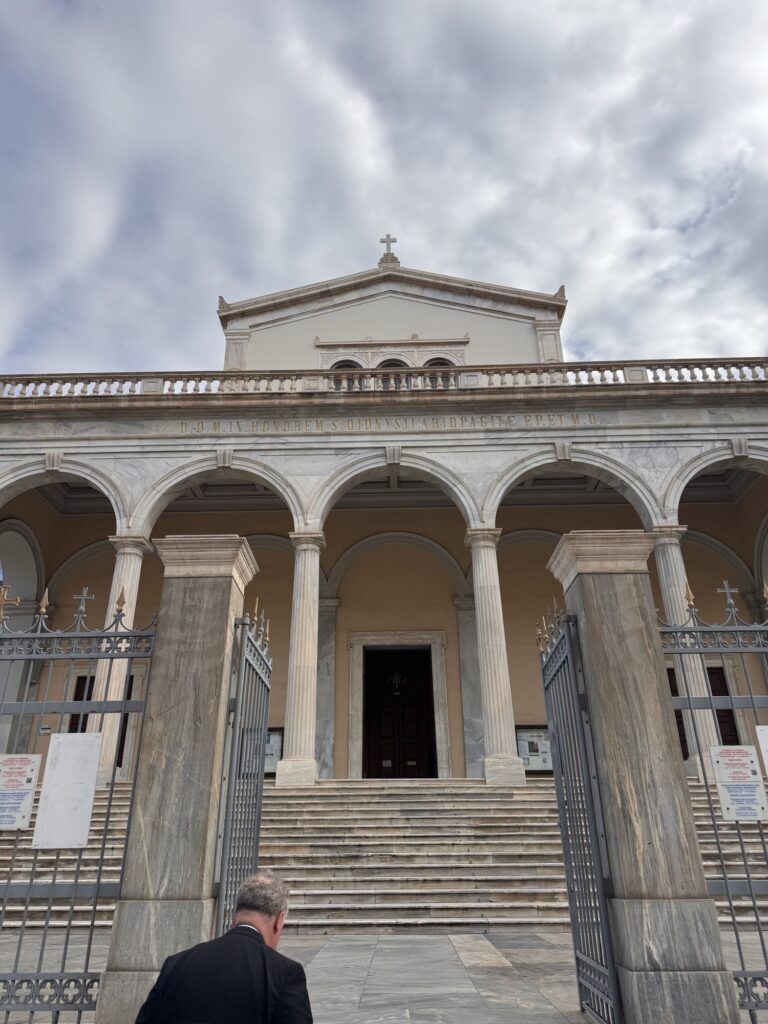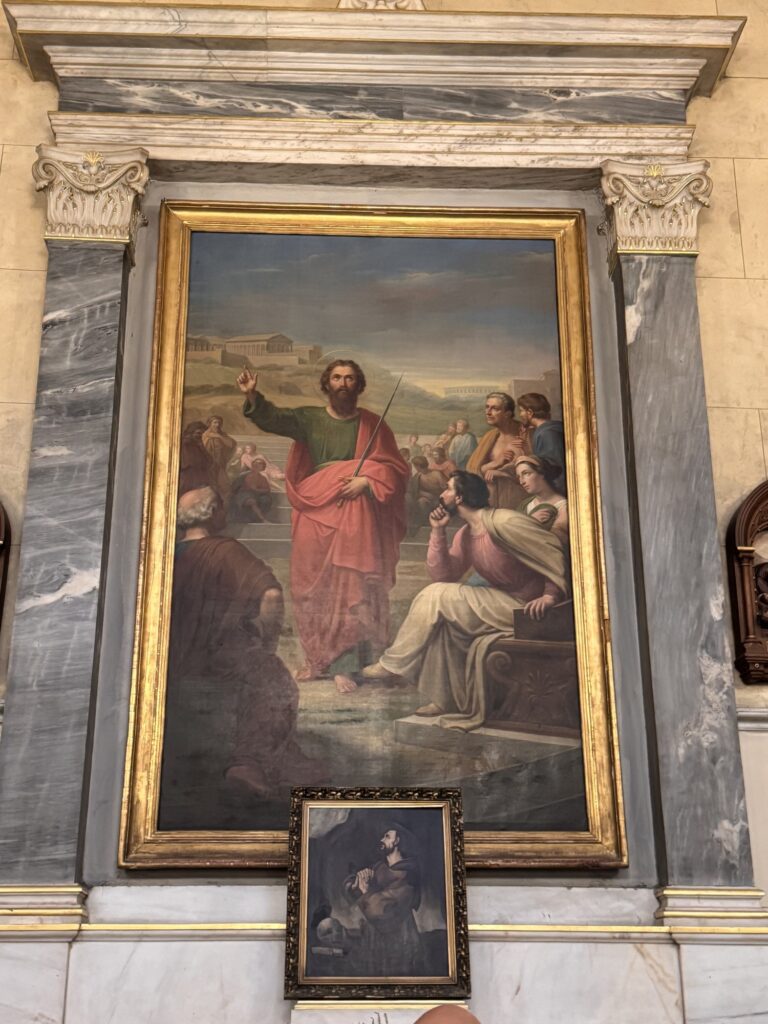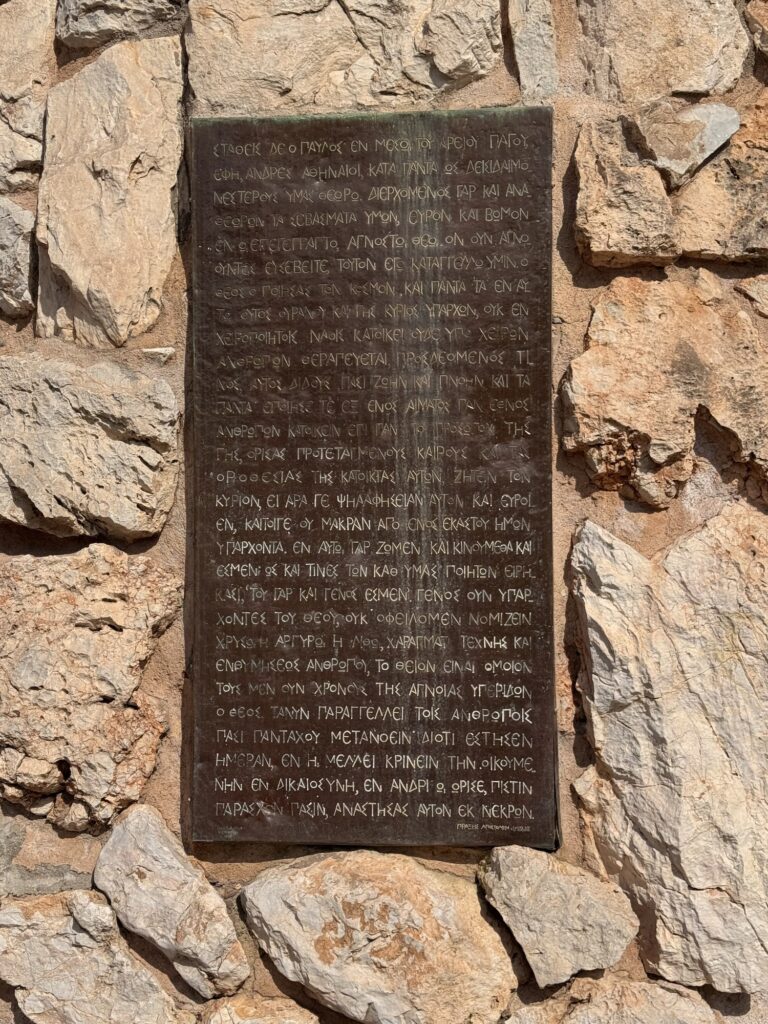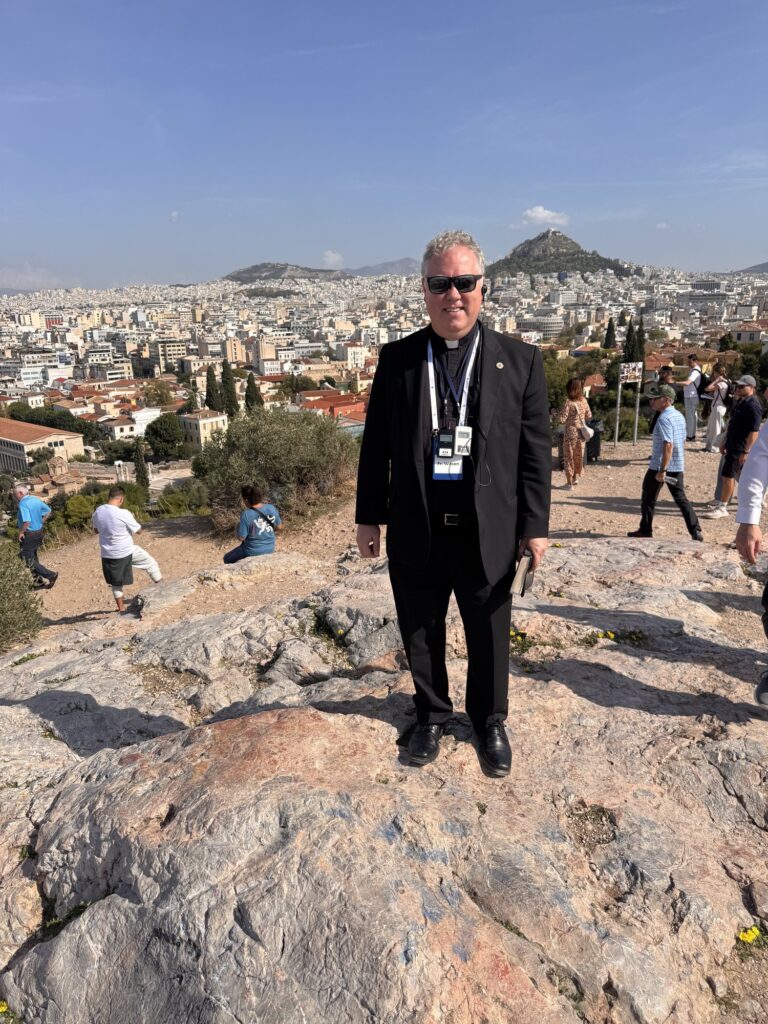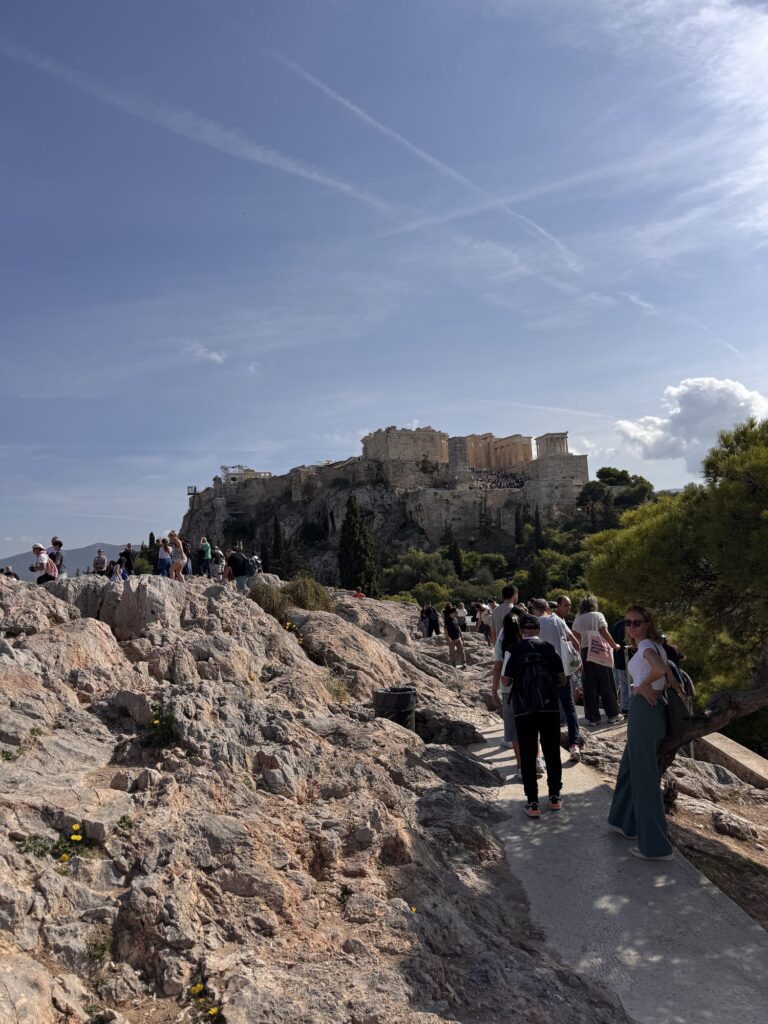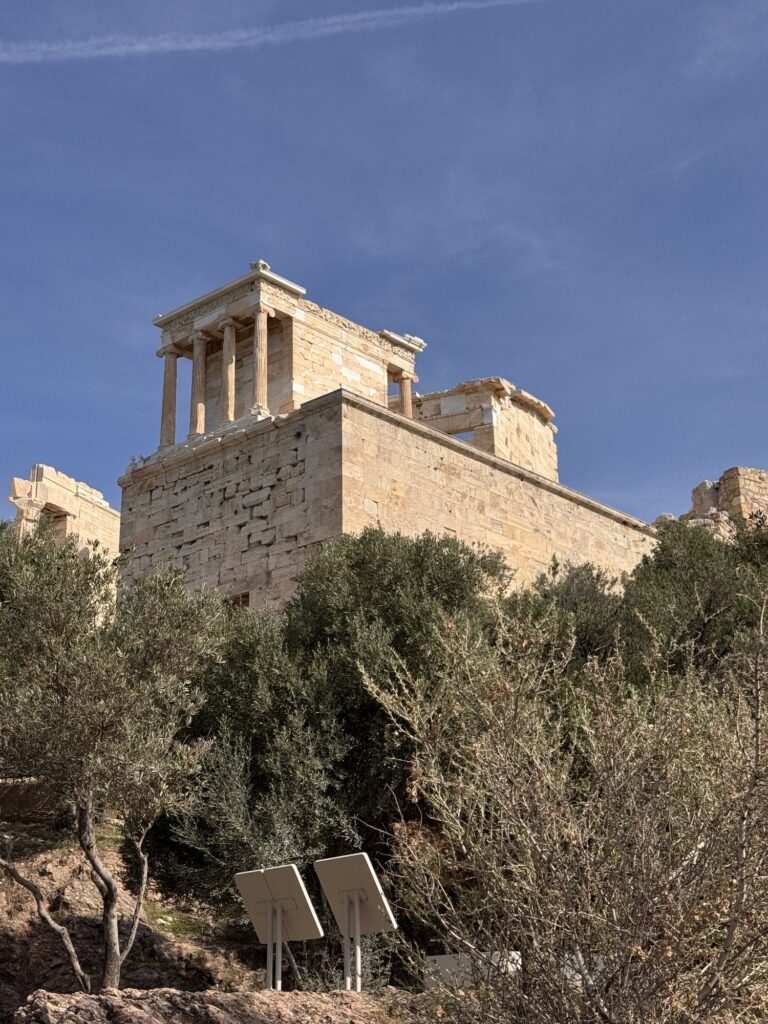
On Friday, October 23, our pilgrims celebrated Mass at the Cathedral of St. Dionysius the Areopagite, the Catholic cathedral of Athens. Dionysius was a member of the Areopagus council and one of the few Athenians who believed when St. Paul preached there (Acts 17:34). The group then climbed the Areopagus, the rocky hill where Paul told the Athenians about the “unknown God” (Acts 17:22-31), and the Acropolis above it.
Homily at the Cathedral of St. Dionysius
What an amazing gift to be here, in the cathedral church of the Catholic Archdiocese of Athens, dedicated to St. Dionysius the Areopagite. We read in the Acts of the Apostles of St. Paul’s presence here in Athens and of his preaching on the Areopagus. In most respects it was very unsuccessful. It was a brilliant sermon, as he revealed to them the unknown God: unknown to them, but known to us, revealed fully in the person of Jesus. Yet there were relatively few converts from his brief time here in Athens.
But there was one significant convert: Dionysius, whom we now know as St. Dionysius the Areopagite (Acts 17:34). This church was built in his honor, to reflect the fruit and the presence of the ministry of St. Paul the Apostle here in Athens.
Today in our first reading we continue to hear from the Apostle Paul, and as we hear from Paul, we hear most especially from the Lord. This is the Word of the Lord: God is the primary author of sacred Scripture, and Paul is an inspired writer. St. Paul is writing to the Ephesians, and he is writing from prison. He sees that his own death is imminent. He is looking death in the eye. He knows that his earthly journey is coming to an end, and in that light he can see things with a unique clarity.
As he writes to the Ephesians, we might consider that these words apply to us. I invite you to consider that this time of pilgrimage is not meant to be simply a pilgrimage that begins and ends. It is an invitation for us, truly, on how to live. We are invited to discover more and more that we truly are pilgrims: a people on a journey to that ultimate and sacred destination, which is to be with God forever.
When we know the destination of our lives, when we know their ultimate purpose, the journey changes. We know that we are here for a time, but this is not why we exist. This is not the destination. We are on a journey. And as St. Paul exhorts the Ephesians, he invites us to consider how we want to be on the journey. How is the Lord inviting us to live on the journey?
One of the graces of a pilgrimage is that when we return home, the pilgrimage does not end. We discover in our daily life, in our daily work, in the ordinary aspects of our lives, that nothing is ordinary for us as Christians when we understand that we are on a sacred journey to be with God forever in heaven. That, I believe, is one of the great graces we should pray for during this pilgrimage: the grace to discover life as a pilgrimage.
And so as he exhorts the Ephesians, he exhorts us: “I, a prisoner for the Lord, urge you to live in a manner worthy of the call you have received, with all humility and gentleness, with patience, bearing with one another through love, striving to preserve the unity of the spirit through the bond of peace” (Ephesians 4:1-3). If we simply reflect on that, St. Paul is inviting us to discover how we might be on the journey.
What a blessing and what a grace that we have come to discover this. It is part of the Gospel, part of the good news. How many people are prisoners of this world? How many people think their ultimate identity is not one given to them by God as a gift of his unconditional love, but an identity that is fragile, that must be earned, that is at risk and can be taken away? How many believe their ultimate destination is this life, with all of its complications and brokenness and dysfunction? How many people don’t even know that life is a journey with a purpose and a destination? How many don’t know that they are beloved by God and created in his image and likeness, or that there is an ultimate truth and meaning to our lives?
As we discover the truth about life as a pilgrimage, we are also invited to ask the Lord for the grace to truly want to share the Gospel with others: to say, “I have discovered something, and I want you to know what I have found.” My friends, this is a gift, and it’s not meant for us alone. It’s meant to be shared.
We see in the Apostle Paul a man who could not keep this gift to himself, who poured himself out at great personal expense, at the cost of his life, and still, from prison. Why? Because he had discovered the One we are all looking for, and his heart, so full of love, could not keep it to himself.
My friends, when we share our faith, we are not imposing anything. We are proposing the answer to the question that is human life, and we are inviting others to respond in freedom to the gift we have received. To keep this to ourselves, worried that other people might be offended or hurt, or might reject us or misunderstand our intentions, is simply to be selfish. How can we not share the gift we have received?
On this journey we make together, this pilgrimage we share, we beg, through the intercession of St. Paul and of St. Dionysius the Areopagite, for the grace to deeply embrace this invitation: to live our lives as a sacred pilgrimage, to conduct ourselves in a manner worthy of that pilgrimage, and to invite others to join us on this great and sacred journey, the pilgrimage of faith, hope and love. It is the pilgrimage of discipleship of Jesus Christ.