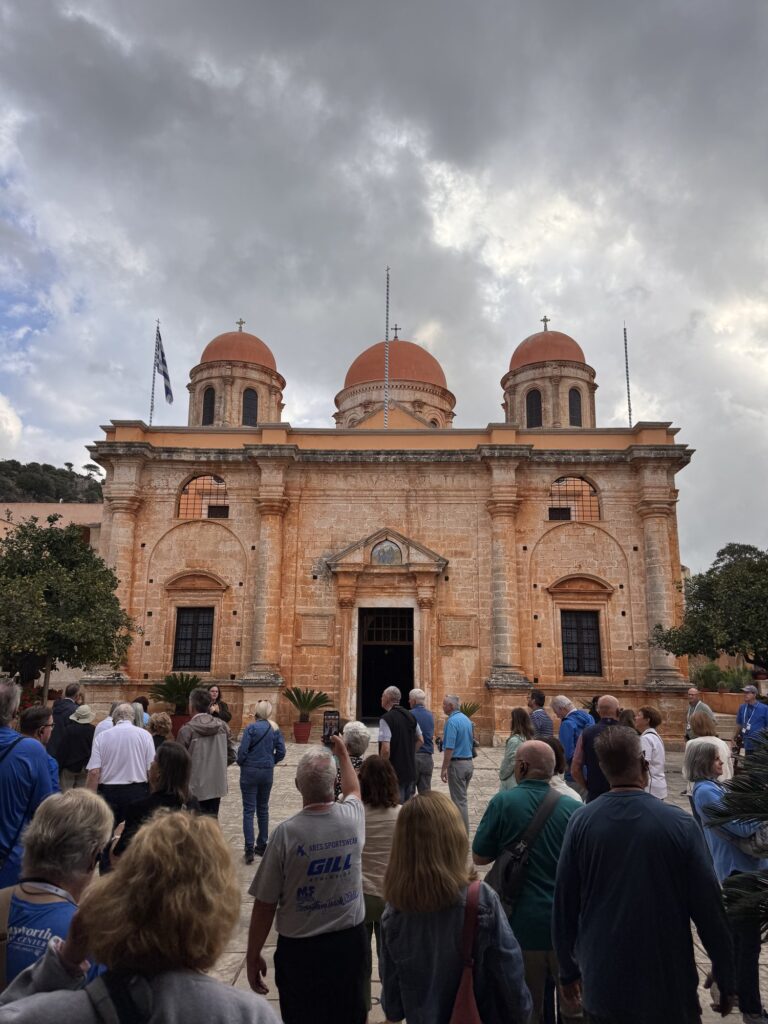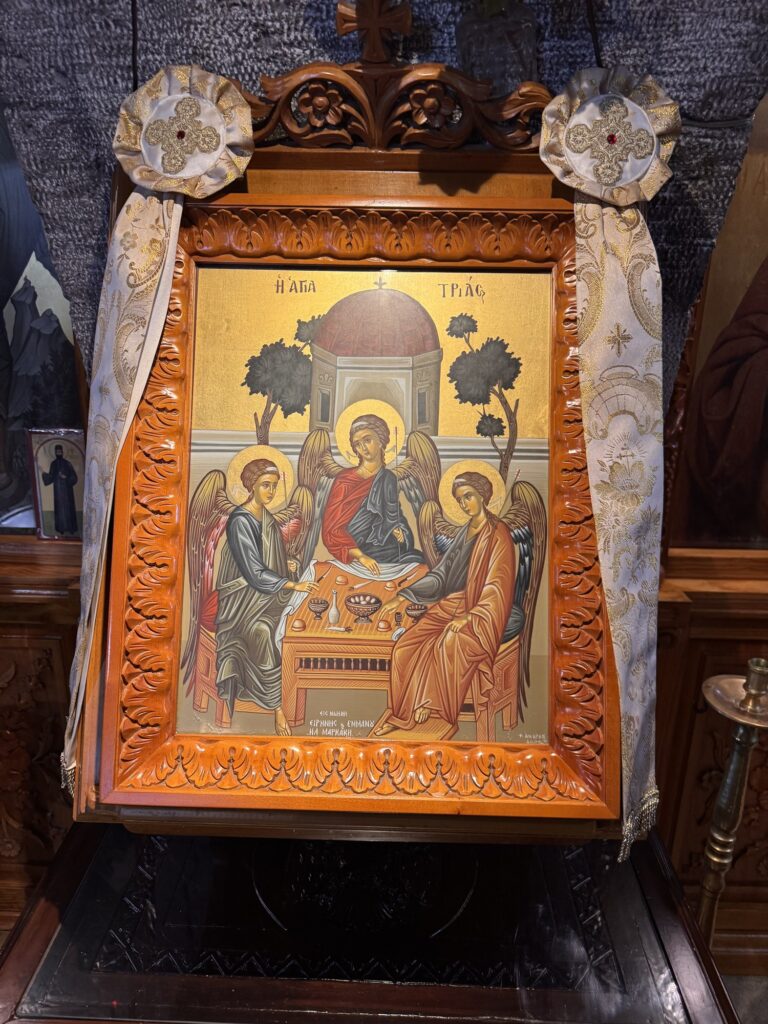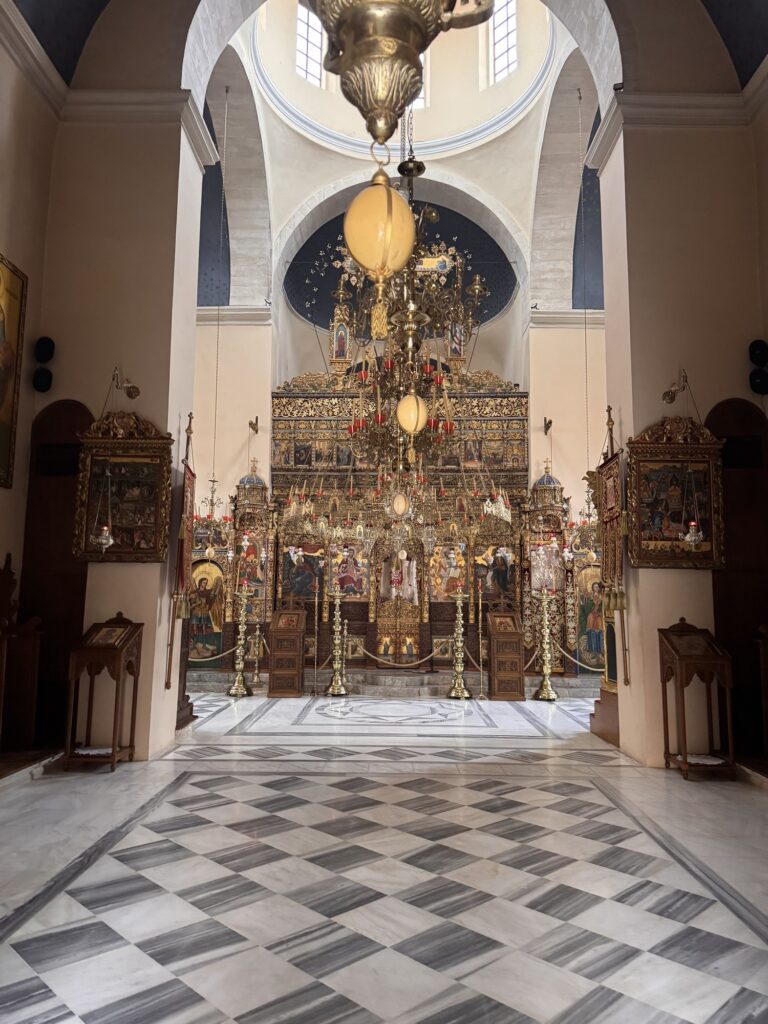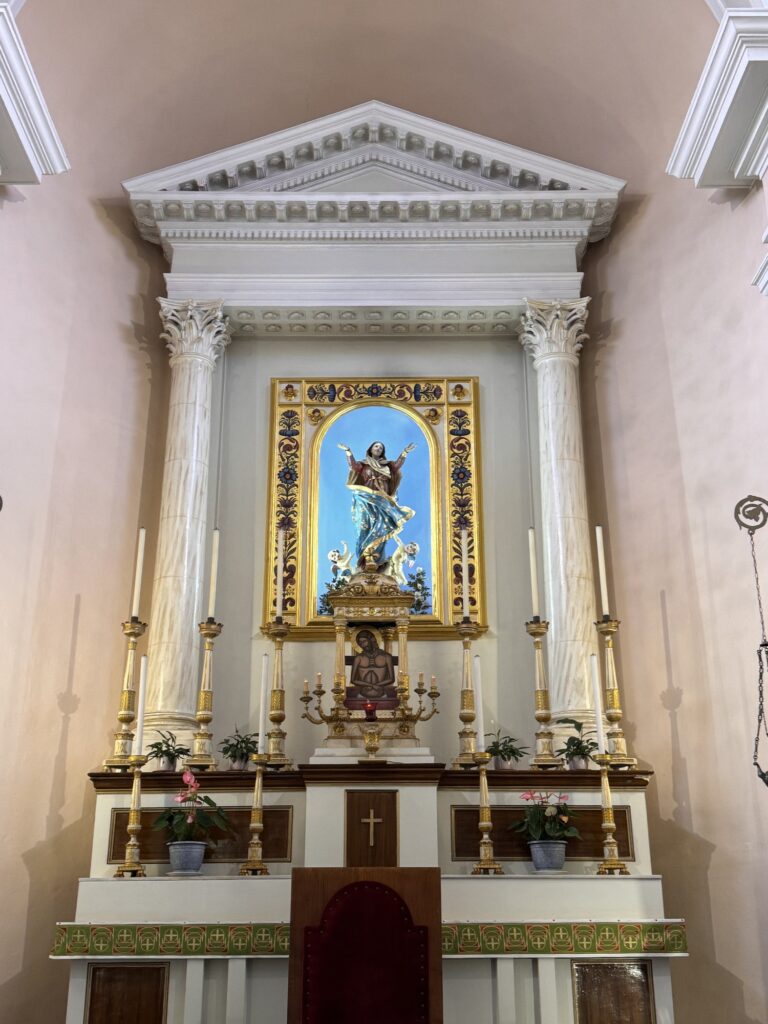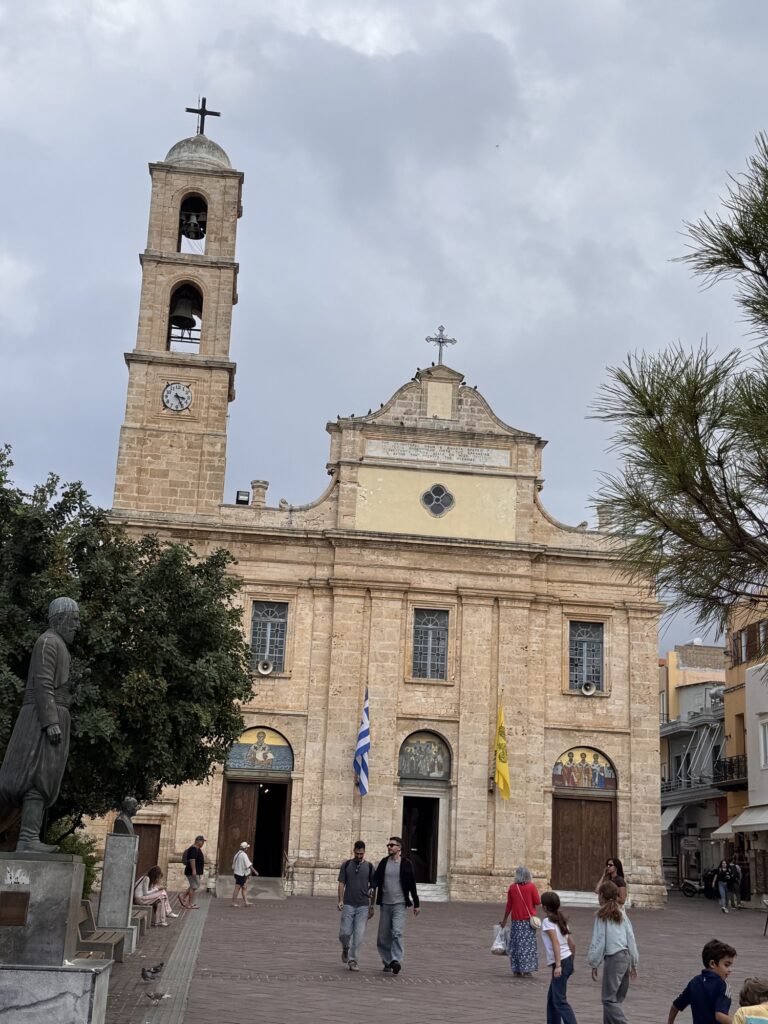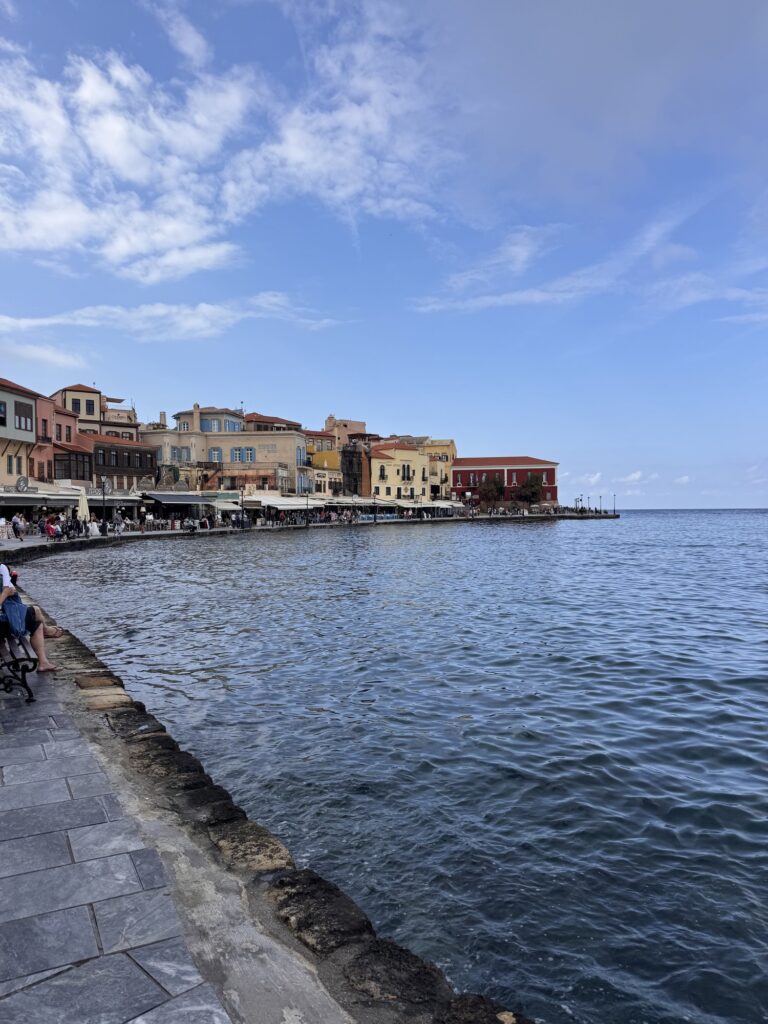
On Saturday, October 24, our pilgrims spent the day on Crete, the island where St. Paul left his companion Titus to organize the Church and appoint presbyters in every town (Titus 1:5). Paul himself had sailed along its southern coast as a prisoner, on the voyage to Rome that ended in shipwreck off Malta (Acts 27). The group visited the Holy Trinity (Agia Triada) monastery, and Fr. Wilson celebrated Mass at the Capuchin-run Catholic church in Chania, a fitting stop for a parish founded by Capuchin friars.
Homily in Chania
We are here in this Capuchin-run church, and what a beautiful connection to our own history at St. Paul the Apostle Parish in Westerville, because our parish was founded by the Capuchin friars. So this feels even more like home for us, here where the Capuchin friars have served for centuries. We are honored to be here today.
We’re invited to consider: What is the plan? We’ve talked about being open to encounters with the Lord. We’ve talked about being pilgrims and how we conduct ourselves on this pilgrimage. What is our Lord asking of us? What is his plan for you and for me?
This week we are hearing our Gospel passages from St. Luke, and they fall within the ten chapters of Luke’s Gospel in which our Lord is journeying from Galilee to Jerusalem. In St. Luke’s Gospel, a portrait of our Lord emerges as someone incredibly focused on the mission he must fulfill, and that mission, of course, is his saving death and resurrection for us.
And so as our Lord journeys to Jerusalem, these teachings are demanding, because he is making it very clear that to be his disciple requires a decision. It requires sacrifice. It requires making him number one. He is on the way to be crucified for our salvation. He sets the way; he sets the pace. But it’s also very clear: if you want to follow me, you need to be all in. That’s the invitation and the call of discipleship.
St. Paul’s letter to the Ephesians gives us a sense of that plan. Paul reflects that our Lord ascended, but he could not ascend unless he first descended (Ephesians 4:9-10). The eternal Son of God descended at the Incarnation, assuming our human nature and entering into the entire human drama, the entire human condition. Ultimately that would culminate in his death on the cross. He fully descended into the human condition, and as he did so, he invites us to be united to him so that we can live his very life, the fullness of Christ himself, and become fully mature (Ephesians 4:13).
St. Paul has a concept of maturity. What I’ve learned as a priest is that maturity is not a function of age. I’ve met very immature 90-year-olds, and I’ve met incredibly mature 16-year-olds. So what is maturity? It is living the life of Christ. That’s the goal, so that we can say with St. Paul, “It is no longer I who live, but Christ who lives in me” (Galatians 2:20).
We might say that true human maturity is nothing less than living as Christ lived, truly living his life. That’s the goal: to be completely configured to the person of Jesus Christ. That’s the Father’s desire for you and for me.
On this Saturday we honor the Blessed Virgin Mary. This is a Pauline pilgrimage; we are in the footsteps of St. Paul. But the Blessed Mother is very much a part of our journey. Just as she accompanied her Son on the way of his cross, just as she accompanied him from the back pew, so to speak, throughout his public ministry, she accompanies us. When we go to Our Lady’s house in Ephesus, this pilgrimage will quickly become a very powerful Marian pilgrimage.
She is the model disciple. In her we find all virtue. She is the Mother of God, and as such she is also our great intercessor. Through her intercession she desires that we be more and more configured to the person of her Son. We’re invited to participate in the Lord’s mission, that Jesus would be known.
Today in this Mass, we pause and ask the Lord for the grace to encounter him, to embrace deeply our pilgrimage of faith with him and toward him. And we pray that his purpose in our life would be fulfilled: nothing less than our growth into full maturity, our growth into the life of Christ. Through the intercession of the Blessed Virgin Mary, may we continue to grow in that desire and that reality, so that we can say, “It is no longer I who live, but Christ who lives in me.”