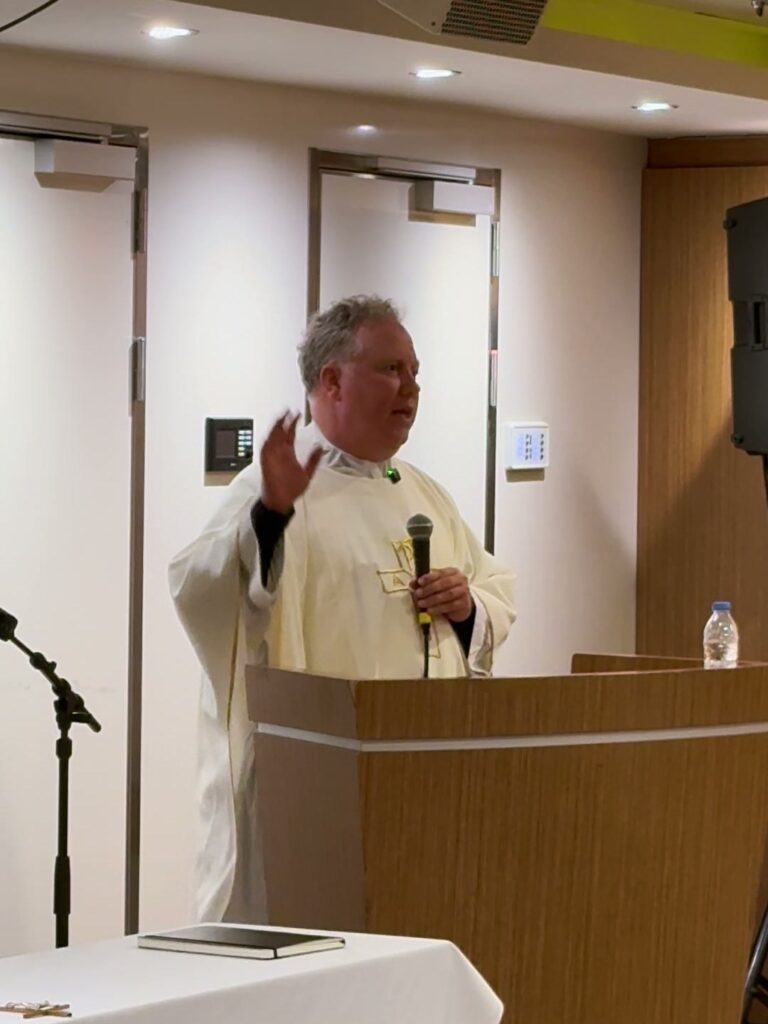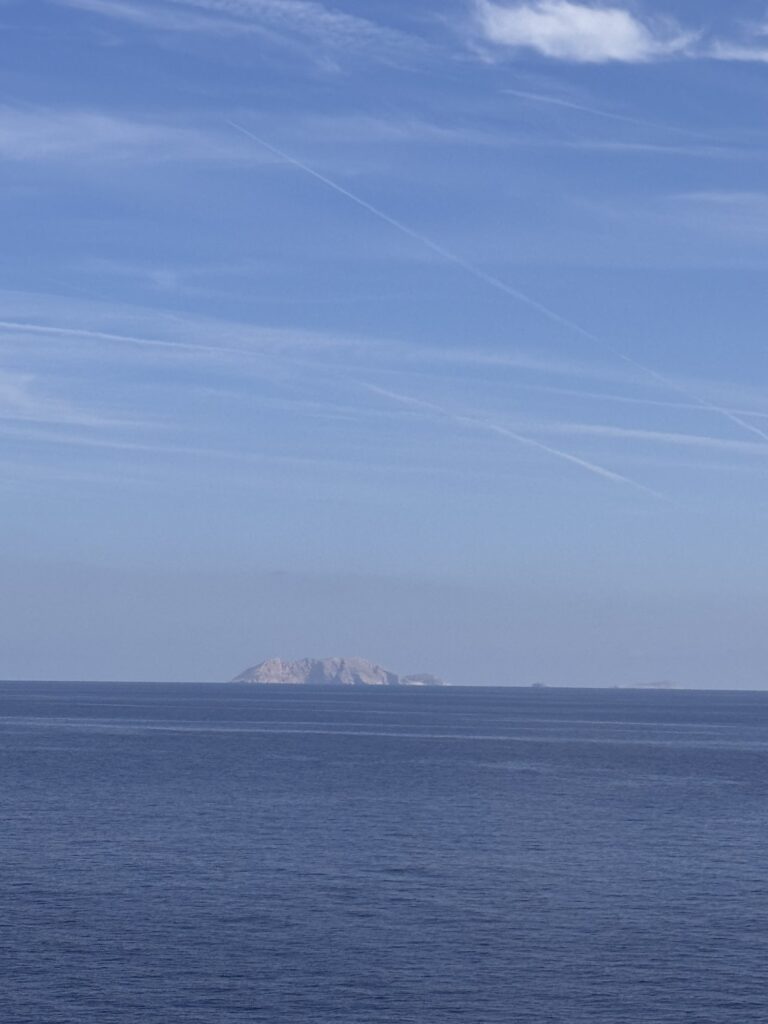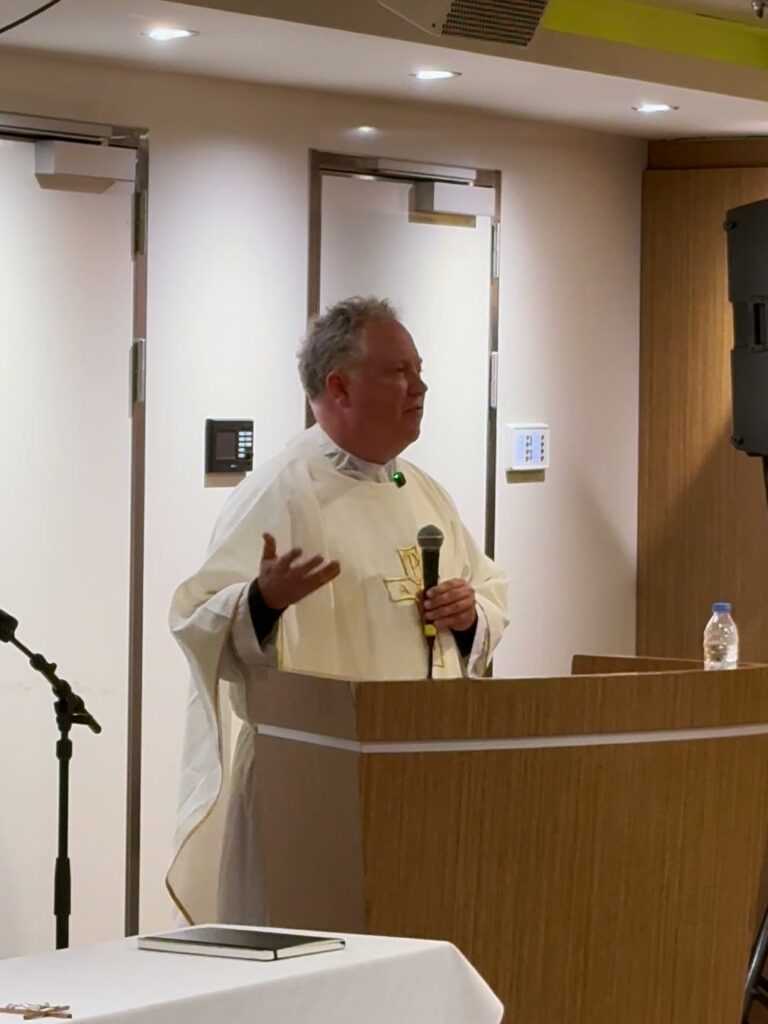
On Sunday, October 25, our pilgrims spent the day at sea, sailing the same waters St. Paul crossed on his missionary journeys and, at the last, as a prisoner bound for Rome. Fr. Wilson celebrated Sunday Mass on board the ship, with the readings from St. Paul’s First Letter to the Thessalonians and the Gospel of the two great commandments.
Homily at Sea
Typically I have to worry about Mass going long, because we have parking lots, and people have to get out of church so more people can get into church. I have none of that today, and I’ve had a whole day to think about this. So I’m sorry in advance!
But what an honor. We are in the footsteps of St. Paul. To our friends who are joining us: we are St. Paul Parish in Westerville, and our parish is coming up on its 100th anniversary. We were established in 1930, and we believe this is the first time our parish has ever made a pilgrimage like this, to follow St. Paul. We are trying to understand our patron, and he is truly extraordinary.
Think back for a minute. Today we heard from St. Paul’s First Letter to the Thessalonians (1 Thessalonians 1:5-10). We will be going to Thessalonica, and we have been in Athens. On his second missionary journey, Paul went from Philippi to Thessalonica, then came down to Athens for that brief visit where he preached his famous sermon at the Areopagus. Then he continued on to Corinth, where he stayed for 18 months, and while he was in Corinth he wrote his letters to the Thessalonians. We were where St. Paul wrote the letter we have heard today. Think about that. That’s just amazing.
These waters we are sailing on are the waters St. Paul crossed many times on his missionary journeys, and then, of course, on that final journey, when he was under guard, having appealed to Caesar to have his case heard in Rome. We are following St. Paul on land and on the sea.
We want to get to know St. Paul, and we know that St. Paul can be a very intimidating figure. In preparation for this pilgrimage, our parish has devoted this entire year to St. Paul the Apostle. Part of my own preparation was rereading the Acts of the Apostles and all of his epistles, reading Pope Benedict’s beautiful Wednesday audience addresses on St. Paul (which, if you haven’t read them, I highly encourage), and reading several other books about St. Paul.
At the end of those general audiences on St. Paul, Pope Benedict mentions the sermons of St. John Chrysostom in praise of St. Paul. They are striking, because St. John Chrysostom is arguably one of the greatest preachers who has ever lived in the Church, honored as one of the great theologians. “Chrysostom” is in fact a nickname; it means “golden-mouthed.” He was such a great preacher that they gave him that name. So to hear St. John Chrysostom speak about St. Paul would be like, I don’t know, hearing Mickey Mantle talk about Babe Ruth: someone truly great at what they do, acknowledging there was someone better.
St. John Chrysostom summarizes the entire life of St. Paul with one word. Can you guess that word? Charity. Love. That is the key to unlocking St. Paul, the key to unlocking what it means to be a disciple, and, of course, the heart of our Gospel today, in which our Lord takes us back to the foundation: the two great commandments, to love God and to love our neighbor (Matthew 22:37-39).
St. John Chrysostom writes beautifully about this virtue: “Paul knew that charity was the crowning virtue and wished to cultivate it with the greatest care.” He notes that charity is unique among the virtues. Some of the virtues we try to acquire as disciples he calls “man-centered,” because we are embodied human beings: the fight with concupiscence, the war on gluttony, the campaign against avarice, the battle against anger. But “charity, on the other hand, is something man shares with God.” All the virtues are contained in the virtue of charity.
We can use the words charity and love interchangeably: the virtue of charity, the call to love. And we know that we live in a world that is deeply confused about the nature of love. We talk about falling in love, falling out of love, the feeling of love. But for St. Paul, love was not a feeling. It wasn’t as if he said, “Oh, I just kind of feel like getting flogged today for the sake of the Gospel.” No, love was a decision, an act of the will. We can choose love even when we don’t feel love. You can see the great consequences of that confusion about love in the culture in which we live. And so we want to imitate our great patron, St. Paul: to choose love, and to allow love to be the key that unlocks for us the entire life of discipleship.
This is how St. John Chrysostom described St. Paul and his love:
You have seen a man traversing the entire earth, for it was his ambition to lead every man to God … as if the entire population of the world were his children. He was always in a hurry, always on the go, always anxious to lead all men to the kingdom of heaven … Like a general or a good doctor, he joined in the fray and gave a helping hand, … becoming all things to those engaged in the conflict. … Since, then, charity is the beginning and the end and the sum of all blessings, let us imitate Paul in this respect, for charity was the secret of his sanctity.
St. John Chrysostom, In Praise of St. Paul
We can think of the reading we hear at most weddings, from 1 Corinthians: “Love is patient, love is kind” (1 Corinthians 13:4). How could Paul write those beautiful words? Because those were the words he lived.
Our Lord calls us to love. We know that we cannot love until we are first loved, and so first we are invited to receive his love. When we come to the Mass, we are renewed once again in the mystery of his love. The Mass is nothing less than the offering of our Lord and Savior Jesus Christ on the cross for our salvation, made once and for all and made present under the signs of bread and wine. Infinite charity.
In a few minutes he will be on that altar, in this ship, in the middle of this sea, and we will be present to the greatest act of charity and love in the history of the universe. We are invited to receive that love. It’s not a love that we earn, not a love that we deserve, not a prize for being good. The Bible tells us he loved us while we were still sinners (Romans 5:8).
We are invited to find our identity in that love. Our self-worth is not based on what we own or what we do, where we live or who our friends are, all the things the world tells us. And I’m sorry if I’m hurting the business of this ship, but you don’t need to have a Rolex to have value in your life! We have value because we are loved by God. That’s our identity, and that is freedom.
Once we have received that love, we return that love to our Lord, who desires a real friendship: “I no longer call you slaves … I have called you friends” (John 15:15). And then we are invited to live that love. That’s why, as pilgrims, we can’t do this alone; we have to journey together. It is in our love for one another that we begin to live the life Jesus calls us to live, and that extends to every person we encounter on this ship: the call to bring the love of Christ to everyone we meet.
As we journey in the footsteps of St. Paul, we are truly inspired by our great patron. In him we see a beautiful example of charity, of divine love. We ask him to intercede for us, and we ask the Lord for the grace that the gift of charity we received at our Baptism might grow within us, so that we might see every opportunity as an opportunity to share the very love of God.