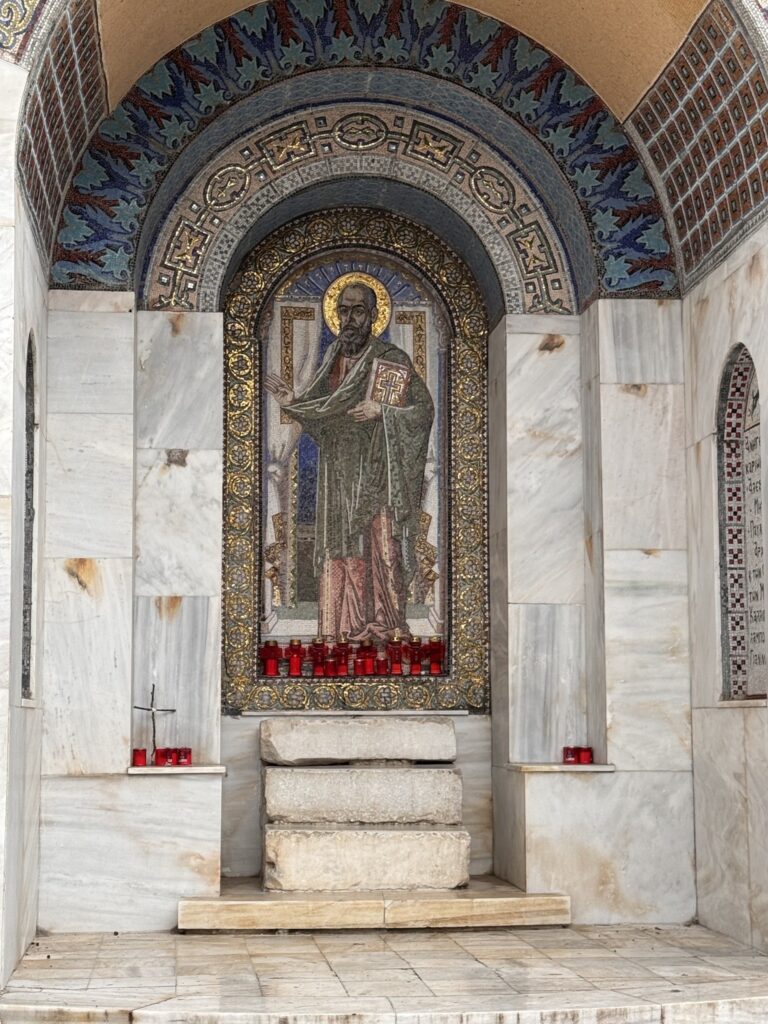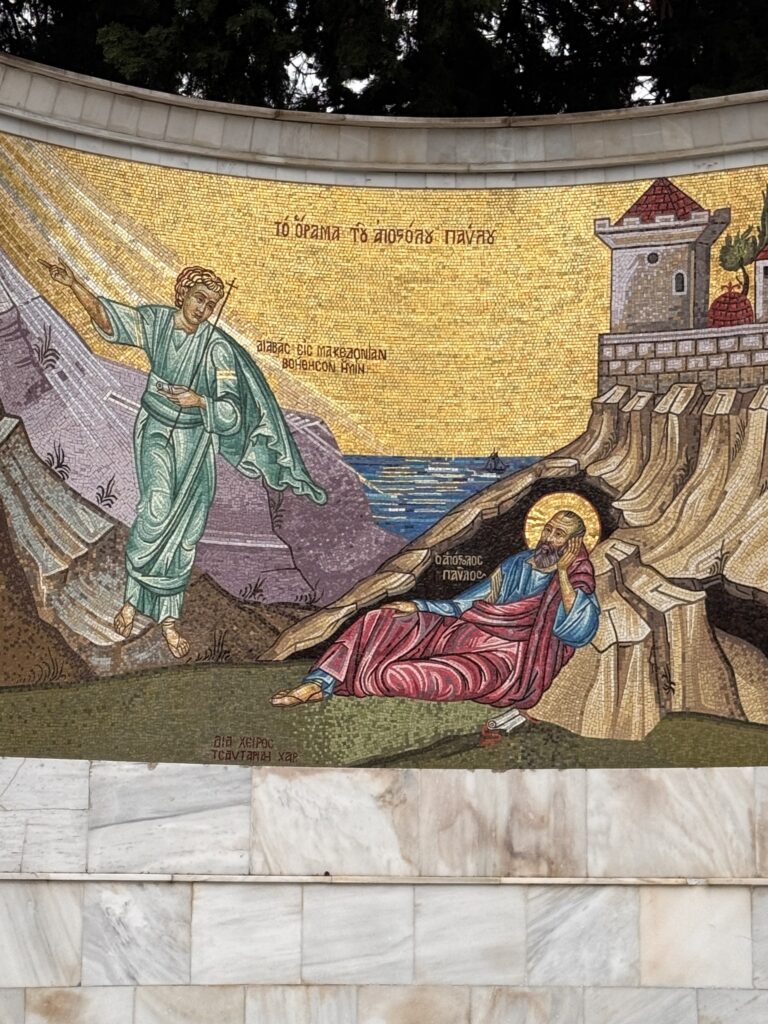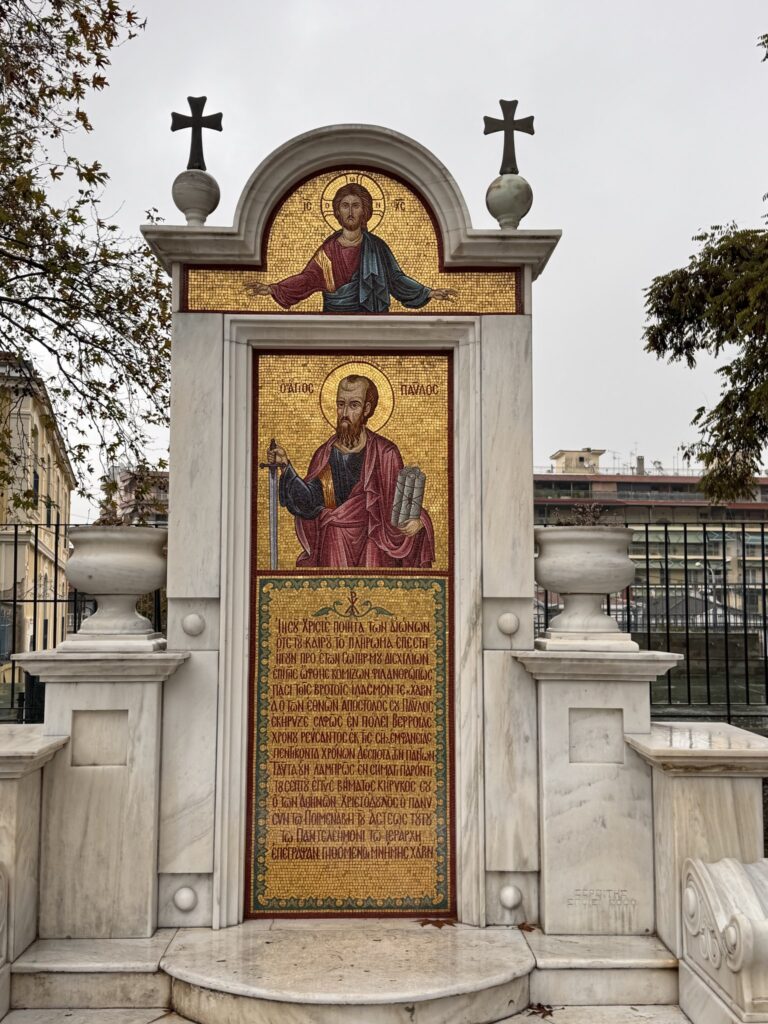
On Saturday, October 31, our pilgrims came to Veria, the ancient city of Berea, where St. Paul preached after being driven out of Thessalonica. Tradition holds that he stood on three ancient marble steps, now the Bema (“step” or “platform”) of St. Paul, to proclaim the Gospel. Today the steps sit in a marble shrine beneath a mosaic of the Apostle, surrounded by mosaics of his journey into Macedonia.
The brethren immediately sent Paul and Silas away by night to Beroea; and when they arrived they went into the Jewish synagogue. Now these Jews were more noble than those in Thessalonica, for they received the word with all eagerness, examining the scriptures daily to see if these things were so. Many of them therefore believed, with not a few Greek women of high standing as well as men.
Acts 17:10-12
From the Steps Where St. Paul Preached
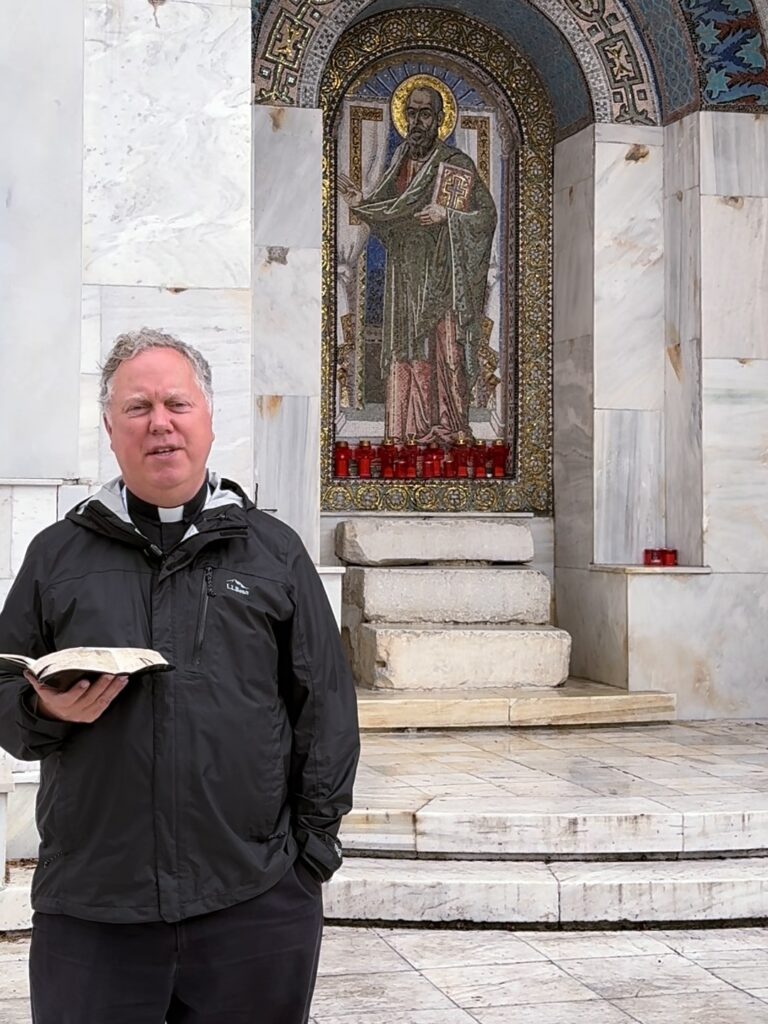
At the Bema, Fr. Wilson read Acts 16:40–17:15 with the pilgrims and reflected on it.
This is a very special moment in our pilgrimage, being in the footsteps of St. Paul. Here are three ancient steps. We’re in Berea, and these steps are believed to be the steps that St. Paul literally stood on as he preached the Gospel.
Let’s take a moment to catch up. On our pilgrimage we went to Philippi, and from Philippi to Thessalonica, and now to Berea. Recall where we were: we encountered Lydia’s baptism. Recall how St. Paul had the big ordeal, was thrown into prison, got out of prison, and then went to visit Lydia. Then Paul and Silas and Timothy departed from Philippi and came to Thessalonica. For three weeks Paul argued with them from the Scriptures, proclaiming that Jesus is the Christ. Some were persuaded, but others set the city in an uproar, crying, “These men who have turned the world upside down have come here also” (Acts 17:6). And the brethren immediately sent Paul and Silas away by night to Berea.
So we are here in Berea, Paul’s next stop after Thessalonica. Recall his first and second letters to the Thessalonians; that was the place he was writing to. This is the place where, traditionally, historically, St. Paul proclaimed the Gospel to the people of Berea. And the people, as we hear, received the word with all eagerness, examining the Scriptures daily to see if these things were so. But when the Jews of Thessalonica learned that the word of God was proclaimed by Paul at Berea, they came there too, stirring up and inciting the crowds.
We see it place after place after place: the difficulty, the struggle for St. Paul. He’s proclaiming the word, and the word is being received, but notice that Scripture: they “turned the world upside down.” He was a total threat to their world, including this accusation that he was proclaiming a king who would be in competition with Caesar.
Now this takes us full circle to the beginning of our pilgrimage. When we started, we were in Athens, and we recalled St. Paul’s time in Athens. He was in Athens just having left Berea, having established the church in Philippi and the church in Thessalonica. He sent Timothy and Silas back to Thessalonica to continue to build the church, and he wanted a report as to how things were going. Paul would go from Athens to Corinth, and it was there that Timothy and Silas gave him the report. And so St. Paul wrote the first and second letters to the Thessalonians from Corinth, which we believe are the very first written letters of the New Testament.
So here we are in the footsteps of St. Paul in Berea. We’re encouraged, first, just to be grateful for this moment. And secondly, as we are disciples of Jesus Christ: if St. Paul went through so many difficulties, we should expect difficulties. We should not expect a Christianity that is easy. We should not expect a Christianity without conflict, where there isn’t some kind of controversy or resistance. We should not be afraid of that.
We see in St. Paul that he is filled with love. He proclaims the Gospel, and that Gospel is at some level controversial. We shouldn’t be afraid of that as we proclaim the Gospel of life, as we proclaim that Christ is life. St. Paul the Apostle, pray for us.